Online reviews have become one of the most influential factors in consumer purchasing decisions. According to DemandSage's 2026 statistics report, 93% of customers read online reviews before making a purchase, and approximately 53% of consumers trust online reviews as much as personal recommendations. For businesses, the revenue impact is substantial: research from Womply, as reported by Forbes, found that businesses with 9 or more recent reviews earn 52% more revenue than average, and those with 25 or more reviews see revenue jump to 108% above average.
This guide examines how AI-powered review management transforms the way businesses monitor, analyze, and respond to customer reviews across platforms.
Why Reviews Matter More Than Ever
The connection between reviews and revenue is well-established across multiple research studies. According to Moz, businesses risk losing 22% of potential customers when a single negative review appears in search results. That figure climbs to 59% with three or more negative reviews.
Research from Reputation.com shows that consumers are 33% more likely to upgrade a review if the business responds within 24 hours. Data compiled by OpenSend in 2026 found that companies responding to just 25% of their reviews average 35% more revenue than those ignoring customer feedback entirely.
| Review Metric | Business Impact |
|---|---|
| 9+ recent reviews | 52% more revenue than average |
| 25+ recent reviews | 108% more revenue than average |
| 1 negative review visible | 22% potential customer loss |
| 3+ negative reviews | Up to 59% customer loss |
| Responding within 24 hours | 33% more likely to get upgrade |
| Responding to 25%+ of reviews | 35% more revenue |
The Manual Review Management Problem
For businesses with multiple locations or a presence across several review platforms, manual review management quickly becomes unsustainable. A restaurant chain with 20 locations might receive dozens of reviews daily across Google, Yelp, TripAdvisor, and industry-specific platforms. Manually reading, categorizing, and responding to each review consumes hours of staff time.
Common challenges with manual review management include inconsistent response times across platforms, inability to identify recurring themes across hundreds of reviews, missed negative reviews that damage reputation before anyone notices, and no systematic way to connect review insights to product or service improvements.
How AI Transforms Review Management
Automated Sentiment Analysis
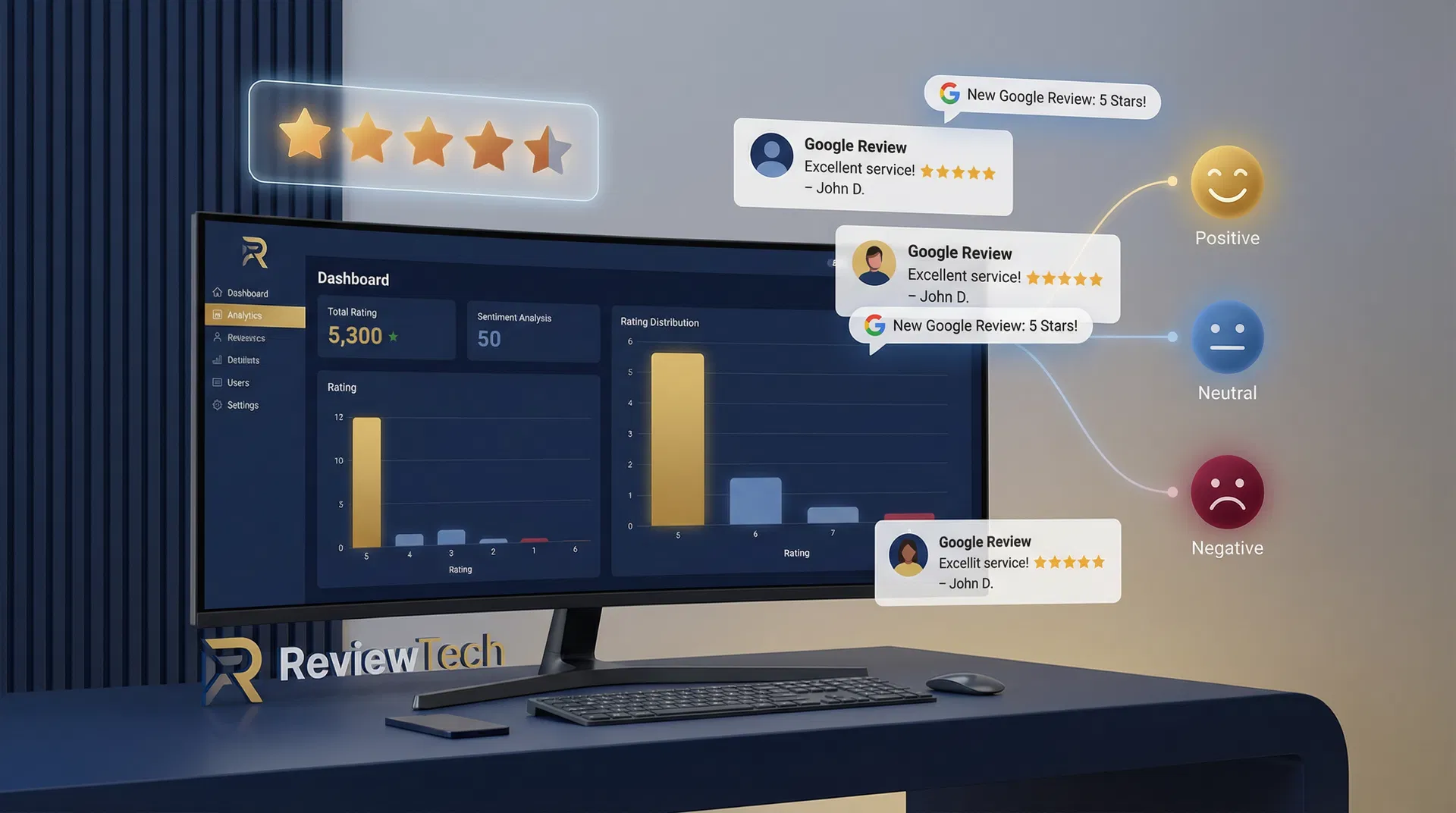
AI-powered sentiment analysis reads every review and classifies it as positive, negative, or neutral — but goes further by identifying specific aspects being praised or criticized. A restaurant review that says "amazing food but terrible parking" contains both positive sentiment about food quality and negative sentiment about accessibility. AI breaks this down at the aspect level, giving businesses granular insight into what is working and what needs attention.
Theme Detection Across Platforms
When reviews are scattered across Google, Yelp, and social media, patterns are invisible to manual reviewers. AI aggregates reviews from all connected platforms and identifies recurring themes. If 15 different customers mention slow checkout times across three different platforms over two weeks, AI surfaces that as a trending issue requiring attention.
Intelligent Response Suggestions
AI can draft contextually appropriate response suggestions based on the review's content and sentiment. For a positive review praising specific staff members, the AI suggests a personalized thank-you that acknowledges the specific compliment. For a negative review about wait times, it suggests an empathetic response that acknowledges the issue and describes steps being taken to improve.
These are suggestions, not automated posts. A human reviewer approves or edits every response before it goes live, maintaining authenticity while dramatically reducing response time.
Review-to-Feedback Pipeline
The most powerful capability of AI review management is automatically converting review insights into actionable feedback items. When multiple reviews mention the same issue, the system can automatically create a feedback post on your internal board, categorized and prioritized based on frequency and sentiment severity. This bridges the gap between external customer voice and internal product improvement workflows.
Setting Up an AI Review Management System
Step 1: Connect Your Review Platforms
Start by connecting all platforms where customers leave reviews. For most businesses, this includes Google Business Profile and Yelp at minimum. The connection process typically involves authenticating with each platform's API to enable real-time review syncing.
Step 2: Configure Sync and Analysis Settings
Set your preferred sync frequency and configure which analysis features to enable. Most businesses benefit from enabling sentiment analysis, theme detection, and auto-categorization from the start.
Step 3: Establish Response Workflows
Define who is responsible for responding to reviews, set target response times, and configure notification rules. AI can route reviews to the appropriate team member based on content — sending food-related reviews to the kitchen manager and service-related reviews to the front-of-house lead.
Step 4: Connect Reviews to Your Feedback Loop
Enable the review-to-feedback pipeline so that recurring review themes automatically generate internal feedback items. This ensures that customer voice from review platforms feeds directly into your product improvement process.
Measuring Review Management ROI
Track these metrics to measure the impact of your AI review management program:
- Average response time — How quickly you respond to reviews across all platforms
- Response rate — What percentage of reviews receive a response
- Sentiment trend — Whether overall review sentiment is improving over time
- Star rating trajectory — Whether your average rating is trending upward
- Review volume growth — Whether more customers are leaving reviews (a sign of engagement)
- Feedback items generated — How many actionable improvements came from review insights
According to an EmbedSocial survey from 2025, firms with 50 or more reviews and a 4.5+ star rating see up to 30% better visibility in local search rankings. Improving your review profile is not just about reputation — it directly impacts discoverability.
The Competitive Advantage
Data from SEO Samba reported via LinkedIn shows that 80% of consumers were prompted by a local business to leave a review in 2025. Businesses that actively manage their review presence — soliciting reviews, responding promptly, and acting on feedback — create a virtuous cycle of improving ratings, increasing visibility, and attracting more customers.
AI makes this cycle sustainable at scale. Instead of choosing between thorough review management and efficient operations, businesses can have both.