The volume of customer feedback modern businesses receive has outpaced the ability of human teams to analyze it manually. Between support tickets, review platforms, social media, email conversations, and in-app feedback, a mid-size company might process thousands of feedback items monthly. AI-powered sentiment analysis has emerged as the technology that makes this volume manageable — and strategically valuable.
According to Gartner research cited by Invesp, 80% of customer service organizations were expected to adopt generative AI technology by 2025. Invesp also reports that 38% of business leaders say their primary AI goal is enhancing customer experience and retention, while 45% of customer service professionals plan to integrate more AI and automation into their workflows.
What Sentiment Analysis Actually Does
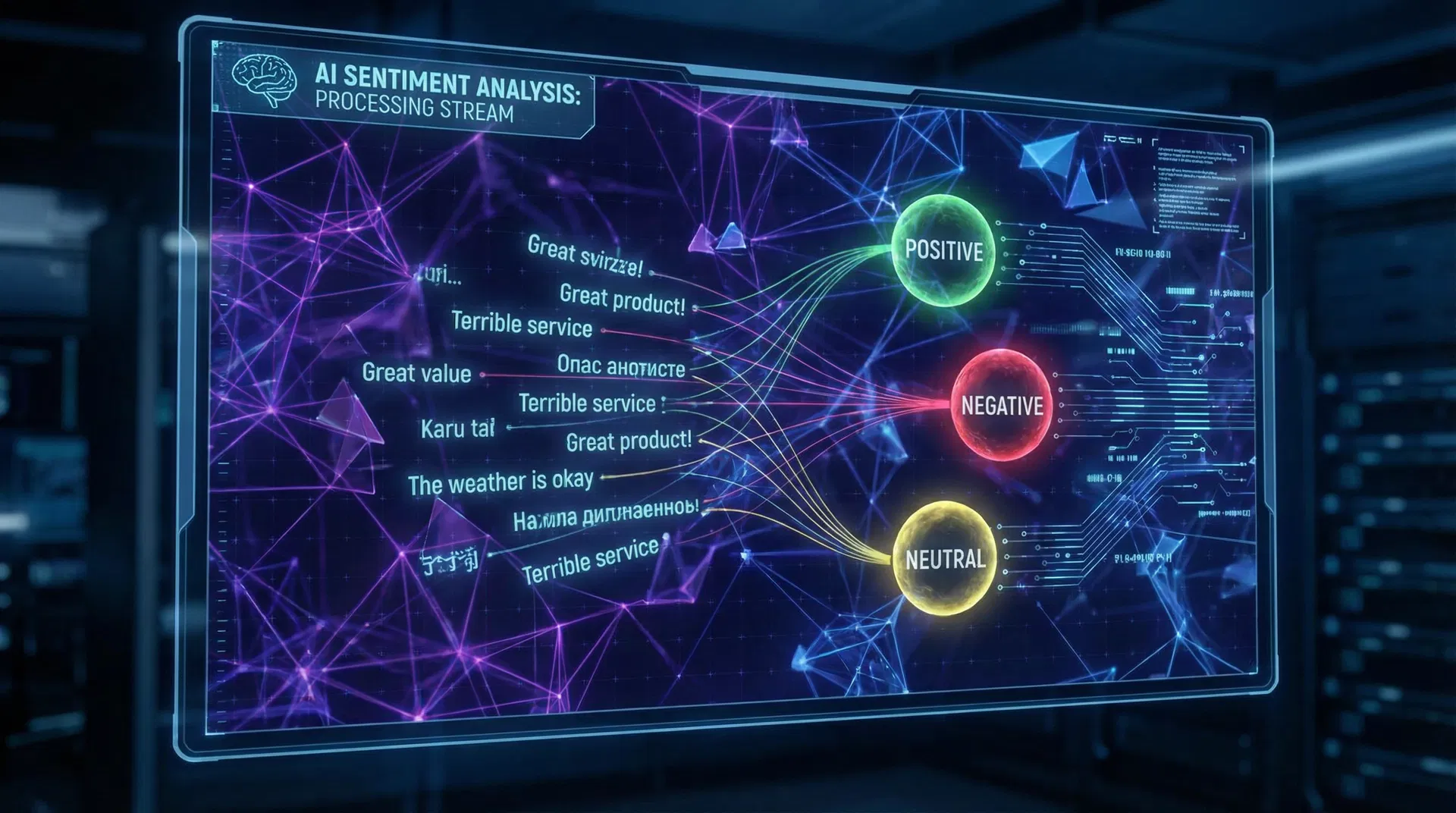
At its core, sentiment analysis uses natural language processing (NLP) to determine the emotional tone of text. But modern AI sentiment analysis goes well beyond simple positive/negative classification.
Document-Level Sentiment
The most basic form classifies an entire piece of feedback as positive, negative, or neutral. A review that says "Great product, love using it every day" is classified as positive. This level of analysis is useful for high-level trend tracking but misses nuance.
Aspect-Based Sentiment
More sophisticated analysis identifies specific aspects within feedback and assigns sentiment to each one independently. A review stating "The onboarding was smooth but the reporting dashboard is confusing" contains positive sentiment about onboarding and negative sentiment about reporting. Aspect-based analysis captures both signals, giving product teams precise information about which areas need attention.
Emotion Detection
Beyond positive and negative, advanced models can identify specific emotions: frustration, excitement, confusion, satisfaction, urgency. A customer who writes "I've been waiting three weeks for a response and I'm about to cancel" expresses both frustration and urgency — signals that require different handling than a calmly worded feature request.
Intent Classification
AI can also classify the intent behind feedback: is this a feature request, a bug report, a complaint, praise, or a question? Automatic intent classification routes feedback to the right team without manual triage.
From Analysis to Action: Practical Applications
Early Warning System for Churn
Sentiment trends over time are powerful predictors of customer behavior. When an account's average sentiment score declines over consecutive months, that pattern often precedes churn. By monitoring sentiment trends at the account level, customer success teams can intervene proactively rather than reactively.
Product Prioritization
When product teams need to decide which improvements to build next, sentiment data adds a crucial dimension to prioritization. A feature request submitted by 50 users with neutral sentiment is different from a bug report submitted by 10 users with highly negative sentiment. The bug may have a greater impact on retention even though fewer people mentioned it.
Support Quality Monitoring
Sentiment analysis applied to support conversations reveals patterns in support quality. If customers consistently express frustration after interactions with a particular support workflow, that workflow needs redesign. If sentiment improves after certain types of responses, those response patterns can be documented and replicated.
Competitive Intelligence
Applying sentiment analysis to competitor reviews on platforms like G2, Capterra, and app stores reveals what customers love and hate about competing products. This intelligence helps product teams identify opportunities to differentiate.
The AI Customer Experience Market
The investment in AI for customer experience reflects the technology's proven value. According to The Business Research Company, the AI in Customer Experience market reached $17.75 billion in 2025 and is growing to an estimated $22.67 billion in 2026, representing a compound annual growth rate of 27.7%.
The broader AI for Customer Service market is expected to reach $83.85 billion by 2033, growing at a CAGR of 23.2% from 2025 to 2033, according to Grand View Research. These growth rates indicate that AI-powered customer feedback analysis is moving from early adoption to mainstream deployment.
Implementation Considerations
Data Quality Matters
Sentiment analysis is only as good as the data it processes. Short, ambiguous feedback ("ok" or "fine") is difficult for any model to classify accurately. Encouraging customers to provide detailed feedback improves analysis quality.
Context Is Critical
The word "sick" means something very different in a healthcare context versus a product review from a younger demographic. Industry-specific and domain-specific tuning improves accuracy significantly.
Human Oversight Remains Essential
AI sentiment analysis should augment human judgment, not replace it. Edge cases, sarcasm, and culturally specific expressions still require human review. The most effective implementations use AI to handle volume and surface patterns, with humans making final decisions on ambiguous cases.
Integration With Existing Workflows
Sentiment analysis delivers the most value when integrated into existing workflows rather than operating as a standalone tool. When sentiment scores feed directly into customer health dashboards, product prioritization frameworks, and support routing rules, the insights become actionable without requiring teams to check yet another dashboard.
Getting Started With Sentiment Analysis
The barrier to entry for AI sentiment analysis has dropped significantly. Modern feedback management platforms include sentiment analysis as a built-in capability rather than requiring separate NLP infrastructure. The key is choosing a platform that applies sentiment analysis across all your feedback channels — not just surveys or just reviews — so you get a complete picture of customer sentiment regardless of where it is expressed.